

Advertisements
Nearly half of U.S. adults say they could not cover a $400 emergency without borrowing. This figure from the Federal Reserve shows how small errors can cause big setbacks.
This short guide explains common money mistakes beginners make and why they happen. It offers clear steps to avoid these issues. The guide is for young adults, recent graduates, and first-time earners in the United States.
The article covers mindset and awareness first, then practical tools. Topics include understanding financial mistakes, emotional spending, budgeting, and building an emergency fund.
Advertisements
It also discusses managing high-interest debt, starting retirement savings, basic tax planning, choosing insurance, and shopping for financial services.
Plus, it covers recognizing investment opportunities and setting realistic financial goals.
Recommendations use data from the Federal Reserve and Bureau of Labor Statistics. They also rely on advice from the Consumer Financial Protection Bureau and IRS tax basics.
Examples mention providers such as Fidelity, Vanguard, Bank of America, and Chase. These show real-world financial options to readers.
Following this guide can improve cash flow and reduce high-interest debt. Readers can build an emergency cushion and make informed retirement contributions.
It will also help users make smart choices in financial services and set achievable long-term goals. The tone is informational and based on U.S. rules.
Key Takeaways
- Common money mistakes often start with skipping a simple budget.
- Beginner money mishaps can be limited with an emergency fund and basic debt plans.
- Reliable sources like the Federal Reserve and CFPB provide practical baseline advice.
- Using mainstream providers such as Fidelity or Chase helps bridge learning to action.
- Following this guide should improve cash flow and long-term financial stability.
Understanding Common Financial Mistakes
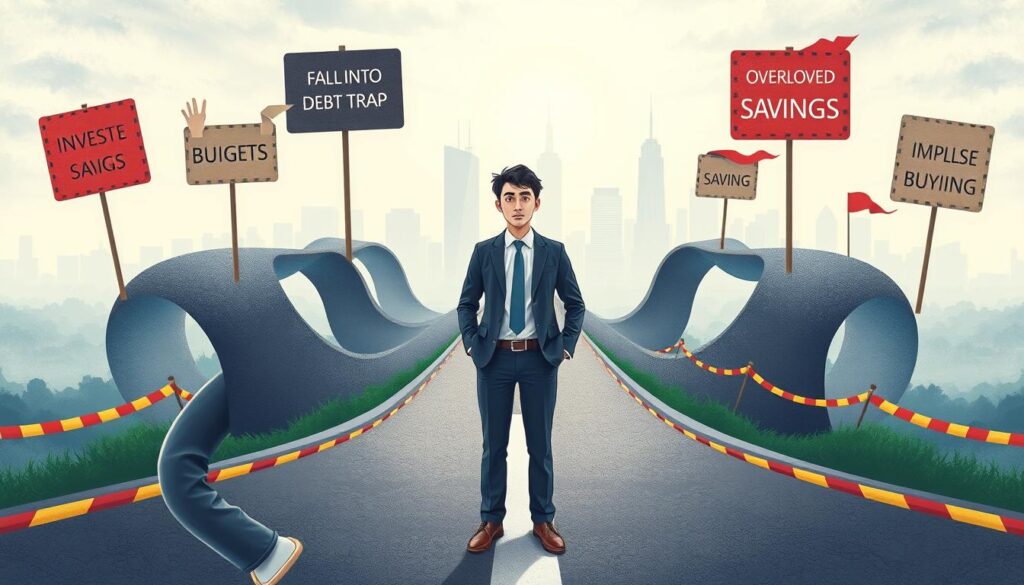
Beginners often make choices that quietly erode future security. A common financial mistake reduces net worth or raises living costs. Examples include high-cost financing, ignoring 401(k) matches, and unchecked subscriptions.
The Impact of Poor Financial Decisions
Poor choices cause harm over time. Credit card APRs range from 17% to 25%, so unpaid balances grow fast from compounding interest. Missed retirement contributions lose employer matches and decades of gains.
Penalties and late fees increase monthly costs and damage credit scores. Lower credit scores raise borrowing expenses for mortgages and auto loans. Delaying retirement savings by ten years can cut a nest egg significantly.
Recognizing Emotional Spending
Emotional spending happens with impulse buys caused by stress, social comparison, or FOMO. Retail therapy and social ads increase these urges. Behavioral finance shows that biases push people to prefer short-term enjoyment over long-term benefit.
Tracking moods before purchases reduces impulsive buys. Consumers who journal feelings before buying make fewer unnecessary purchases. Common beginner mistakes include upgrading lifestyle after raises, frequent takeout, subscription creep, and costly financing.
Awareness of these patterns helps avoid mistakes. Recognizing triggers and costs makes it easier to take practical steps like budgeting.
Ignoring a Budget
Many newcomers treat budgeting as optional. They miss how a simple plan controls cash flow and limits waste.
It also speeds saving and debt payoff. Clear budgets reduce guesswork. They prevent common money mistakes.

Importance of Creating a Budget
Budgeting is the foundation for financial control. It shows income versus expenses. It highlights where money leaks occur.
One starter is the 50/30/20 rule: 50% for needs, 30% for wants, and 20% for savings and debt.
This split adapts to different incomes, family sizes, and regional costs. A working budget helps prioritize bills.
It helps set savings goals and track progress. Ignoring this step is a common money error for beginners.
Tools for Budgeting
Beginners should pick tools that fit their habits. Apps like Mint, YNAB, and Personal Capital automate tracking.
Major banks like Chase, Wells Fargo, and Bank of America offer spending trackers. They show transactions inside accounts.
Spreadsheets in Google Sheets or Excel suit those wanting control. Envelope or cash systems help people needing behavioral limits.
Common Budgeting Mistakes
Overly rigid budgets break down fast. Budgets that never change fail when income or family needs shift.
Small recurring costs, like streaming and subscriptions, often go untracked. Ignoring irregular expenses causes surprise shortfalls.
Relying on a mental budget without checking bank statements leads to drift. This is a frequent mistake beginners make.
Start by averaging three months of income and spending. Automate bill payments and savings transfers. Review budgets monthly.
Separate one-time from recurring costs. Set alerts for overspending categories to stay on track.
Underestimating Emergency Funds
An emergency fund is a basic safety net that protects against sudden shocks. Many newcomers make money mistakes by thinking small savings can cover big surprises. This guide explains what emergencies count, the risks of low funds, and steps to build a reserve.
Why an emergency fund matters
Unexpected medical bills, job loss, and urgent car or home repairs drain finances fast. Without a fund, people rely on high-interest credit cards or tap retirement accounts. Cashing out a 401(k) brings penalties and loses future compound growth.
Data from the Federal Reserve and CFPB show many Americans lack enough savings for a $400 emergency. This gap extends recovery time and raises chances of long-term debt. Avoiding these beginner mistakes reduces stress and protects goals.
Sizing the emergency fund
Start with a small goal of $500–$1,000 if your fixed costs are low. Most households should save three months of essential living costs. Those with irregular income or higher risks should save six months or more.
To calculate essentials, add rent or mortgage, utilities, food, insurance, and minimum debt payments. Keep the fund liquid in an FDIC-insured, easy-to-access account. High-yield options include Ally, Marcus by Goldman Sachs, and Discover.
Newcomers often make the mistake of placing emergency cash in hard-to-access investments. Liquidity is more important than returns for this safety buffer.
Practical ways to build the fund
Automate regular transfers to a savings account to ensure steady progress. Direct part of each paycheck or set recurring transfers after payday.
Use windfalls like tax refunds and work bonuses to quickly boost savings. Also, cut nonessential spending and move that money into the fund.
| Strategy | Example | Expected Timeframe |
|---|---|---|
| Starter goal | Save $500–$1,000 | 1–3 months with modest cuts |
| Short-term reserve | 3 months of essentials | 3–9 months depending on income |
| Extended reserve | 6+ months for irregular income | 6–18 months based on risk |
| Account choice | Ally, Marcus, Discover high-yield savings | Immediate access, FDIC-insured |
| Funding methods | Automate transfers, use refunds/bonuses | Ongoing |
Building a reliable emergency fund prevents many beginner money mistakes. Saving regularly, making smart calculations, and keeping cash accessible avoids common beginner errors.
Accumulating High-Interest Debt
High-interest consumer debt can quickly ruin a budget. Many readers make money mistakes by using credit cards and payday loans as quick fixes. Small balances can grow large when APRs are over 20% and payments are missed.
A clear plan helps beginners avoid these money errors.
Credit card interest and late fees hurt credit scores when payments are late or utilization rises. Paying only the minimum causes slow debt growth.
For example, a $3,000 balance at 19% APR with a 3% minimum payment can take decades to repay. This pattern costs thousands in interest and is a common financial mistake beginners make.
The Dangers of Credit Card Debt
High APRs let debt grow even without new purchases. Missed payments cause penalties and can lead accounts to collections. This lowers your FICO score and raises borrowing costs.
Paying only minimums stretches repayment time. A $2,500 balance at 24% APR with a 2.5% minimum payment takes many years to clear. Interest paid often exceeds the original charge.
Knowing these facts helps avoid repeating common money mistakes.
Strategies to Manage Debt
Start by listing your balances, APRs, and monthly minimum payments. This snapshot helps you prioritize and avoid money errors.
- Avalanche method: Put extra money toward the highest-rate account to save on interest.
- Snowball method: Focus on the smallest balance first to get quick wins and build momentum.
- Consider 0% APR balance transfers from Chase, Citi, or Discover to pause interest. Check fees and new APR carefully before deciding.
- Look into debt consolidation loans from trusted banks with lower rates to simplify payments and pay less interest.
- Negotiate with creditors or ask about hardship programs for temporary help during tough times.
- Seek advice from non-profit counseling agencies like the National Foundation for Credit Counseling for personalized plans.
To avoid future problems, automate full or larger payments and keep a small emergency fund. Using a secured or low-limit card responsibly can rebuild credit without repeating common money mistakes.
Overlooking Retirement Savings
Starting retirement savings late is one of the most costly financial mistakes beginners make. Small early contributions grow through compound interest. This growth often outpaces larger deposits made later.
A clear plan helps avoid common financial pitfalls. It also reduces the risk of blunders newcomers often face.
Importance of Early Retirement Savings
Compound interest means your earnings create more earnings over time. If you earn a 7–8% real return, starting at 25 can double or triple your balance compared to starting at 35.
Capturing an employer match in a 401(k) is like getting free money. Missing this match is a common financial mistake for beginners.
Starting early also lowers monthly savings pressure. A 25-year-old saving 6% of their salary often ends up with more than a 35-year-old saving 10%.
Automatic escalation, raising contributions by 1% each year, builds saving habits. It also helps avoid emotional spending decisions.
Retirement Accounts Explained
Employer plans like 401(k) and 403(b) use payroll deductions and may offer employer matches. Traditional IRAs accept pre-tax contributions and have taxable withdrawals in retirement. Roth IRAs use after-tax contributions and offer tax-free qualified withdrawals.
Self-employed workers can use SEP IRAs for higher contributions and tax-deferred growth. Contribution limits change over time with IRS guidance.
Catch-up contributions help those aged 50 and older save more. Providers like Vanguard, Fidelity, and Charles Schwab offer low-cost index funds and target-date funds for easy diversification.
To avoid financial pitfalls, first contribute enough to get the full employer match. Next, set automatic increases to raise your savings rate yearly.
Pick diversified, low-cost funds such as total market or target-date funds. Avoid early withdrawals unless under qualifying circumstances to prevent penalties and taxes.
| Account Type | Tax Treatment | Best For | Typical Provider Examples |
|---|---|---|---|
| 401(k) / 403(b) | Pre-tax contributions; taxable withdrawals | Employees with employer match | Fidelity, Vanguard, Schwab |
| Roth IRA | After-tax contributions; tax-free qualified withdrawals | Young savers expecting higher future tax rates | Vanguard, Fidelity, Schwab |
| Traditional IRA | Pre-tax or deductible contributions; taxable withdrawals | Savers needing tax deduction now | Vanguard, Fidelity, Schwab |
| SEP IRA | Pre-tax contributions for self-employed; taxable withdrawals | Freelancers and small-business owners | Fidelity, Vanguard, Charles Schwab |
Neglecting Financial Education
Many beginners underestimate how learning about money can prevent costly errors.
Ongoing financial education helps people avoid traps in credit, mortgages, investing, and taxes.
Studies show a clear link between literacy, better retirement readiness, and improved credit outcomes.
Resources for Learning about Finances
Reliable resources offer step-by-step guidance to avoid financial mistakes beginners often make.
Free options include Consumer Financial Protection Bureau guides, IRS publications, Investopedia articles, and Khan Academy personal finance lessons.
Coursera and edX provide structured courses for those wanting a deeper dive into finances.
Recommended books give practical frameworks to help beginners.
“The Simple Path to Wealth” by JL Collins explains investing in plain language.
“Your Money or Your Life” by Vicki Robin and Joe Dominguez teaches aligning spending with goals.
Podcasts like Planet Money and ChooseFI make complex ideas easy to follow for busy listeners.
Local community resources also deserve attention.
Nonprofit credit counseling agencies run workshops on budgeting and debt.
Employers sometimes offer financial wellness programs and seminars on benefits, retirement plans, and beginner money mistakes.
The Benefits of Financial Literacy
Financial literacy produces real results.
People with stronger knowledge budget better, save more, and invest more wisely.
They spot predatory products and use employer matches, like 401(k) contributions, to their advantage.
To build skills, set a simple learning plan.
Aim for a short monthly goal, practice in a simulated investing account, and apply one lesson immediately.
For example, update a budget, open an IRA, or compare interest rates.
This steady approach reduces beginner money mistakes and lowers the chance of costly repeats.
Failing to Plan for Taxes
Tax planning cuts surprises and lowers what a person owes when done early. Beginners often overlook withholding, estimated taxes, and the difference between taxable and tax-advantaged accounts.
Getting a grip on these basics helps avoid common money errors for beginners.
Basics of Tax Planning
Proactive tax planning reduces liabilities and prevents year-end shocks. Workers should check paystubs and update Form W-4 to match life changes like a raise or a new dependent.
Freelancers must estimate quarterly payments to cover income and self-employment tax. Know the difference between Roth and Traditional accounts.
Roth contributions grow tax-free for qualified withdrawals. Traditional accounts lower taxable income now but are taxed at withdrawal.
Capital gains tax rates favor long-term holdings held more than a year. Tax credits such as the Earned Income Tax Credit and Child Tax Credit can cut tax bills directly.
Common deductions include mortgage interest and student loan interest. Use IRS resources, reputable tax software like TurboTax, H&R Block, or TaxAct, or hire a qualified preparer when situations get complex.
These steps reduce common financial mistakes beginners make around tax time.
Common Tax Mistakes to Avoid
- Underwithholding that leads to penalties and a large tax bill.
- Missing eligible credits or deductions because records are scattered.
- Cashing out retirement accounts early, triggering taxes and penalties.
- Misclassifying income for independent contractors and gig workers, which can understate taxes owed.
- Failing to set aside funds for self-employment tax or estimated quarterly payments.
Keeping clear records prevents many financial pitfalls for novices. Store receipts, W-2s, and 1099s digitally. Track investment sales and dates to separate short-term from long-term capital gains.
Practical steps include reviewing withholding, organizing documentation, and consulting a CPA for complex returns.
Tax-efficient moves such as tax-loss harvesting in taxable accounts or holding investments longer to hit lower long-term rates can limit tax drag on returns.
These strategies reduce financial mistakes beginners often repeat.
Making Impulse Purchases
Impulse buying often causes new savers to lose money quickly. Many begin with a quick click or a mall detour. Small buys can add up and lead to big mistakes later.
Knowing why people buy impulsively helps break the habit. Behavioral finance shows that present bias and decision fatigue push quick spending. Social comparison on Instagram and scarcity marketing increase the urge. Emotional triggers like boredom or stress make self-control weaker.
Strategies to Avoid Impulse Spending
Clear steps help stop impulsive buys. A 24- to 72-hour waiting rule reduces emotional purchases. Make a wish list, then review it later to see if the item is still wanted.
Unsubscribe from retailer emails and use browser blockers during work hours. Set card purchase limits and include small “fun money” in the budget for treats.
Tools can enforce discipline. Card controls from Chase or Bank of America let users lock cards, create virtual ones, and set alerts. Savings accounts can hold money for planned big buys. Track spending weekly to find and fix common money mistakes.
The Psychology Behind Impulsive Buying
Many purchases happen for instant gratification. Shoppers prefer short-term pleasure more than long-term goals due to present bias. After many decisions in a day, decision fatigue lowers self-control and increases spending.
Social media drives social comparison. Seeing friends or influencers with new items pressures people to match lifestyles. Scarcity tactics like limited-time offers create urgency and reduce careful thinking.
Emotions also play a role. Stress, loneliness, and celebrations can trigger unplanned spending. Recognizing these feelings can reduce money mistakes and prevent costly errors for beginners.
| Strategy | How to Implement | Expected Benefit |
|---|---|---|
| Cooling-off rule | Wait 24–72 hours before nonessential buys | Reduces impulse purchases and buyer’s remorse |
| Wish list | Save items to review after waiting period | Filters wants from needs and limits unnecessary spending |
| Marketing controls | Unsubscribe emails; use browser blockers | Less temptation from targeted ads |
| Card controls | Use bank tools like virtual cards and alerts (Chase, Bank of America) | Instant oversight and spending limits |
| Budgeted fun money | Allocate a small discretionary allowance each month | Satisfies desires without derailing goals |
| Weekly tracking | Review transactions to spot impulse patterns | Identifies trends so corrective steps can be taken |
Skipping Insurance Coverage
Choosing to skip insurance can seem like a way to save money now. However, it creates real exposure later. Many people make financial mistakes when they underestimate how quickly illness, accidents, or property loss can drain savings.
This short guide outlines key policies, the risks of going uninsured, and practical steps to compare coverage.
Types of protection every new household should review
Health coverage is essential. Use HealthCare.gov during open enrollment when a Marketplace plan is needed. Employer plans may offer better premiums and networks.
Check eligibility for Medicaid when income limits apply. Review FSA and HSA options to lower taxable costs and pay for care.
Auto insurance meets state minimums in some places, but minimum limits often leave drivers underinsured. Compare liability, collision, and comprehensive options to pick reasonable deductibles and limits.
Renters insurance protects personal property and liability for a small monthly fee. Verify coverage limits and replacement cost terms.
Homeowners need dwelling and personal property protection against catastrophic losses. Short-term and long-term disability policies guard against lost income when illness or injury prevents work.
Term life insurance offers straightforward coverage for those with dependents. An umbrella liability policy extends protection above base limits for added peace of mind.
How skipping coverage translates into severe costs
Medical debt remains a frequent cause of financial distress in the U.S. Even one moderate hospital bill can wipe out an emergency fund. It may force high-interest borrowing.
A single at-fault car accident without enough auto liability can lead to judgments and wage garnishment.
Without homeowners or renters insurance, a house fire or theft can erase years of possessions and savings. Losing income without disability coverage may require draining retirement accounts or relying on credit cards.
These are common money errors for beginners that compound quickly.
Practical steps to avoid costly insurance mistakes
Compare plans during open enrollment and when life changes occur. Evaluate employer benefits before assuming Marketplace plans are always best. Use trusted comparison tools and consult independent agents to check rates and policy terms.
Policygenius and NerdWallet provide side-by-side quotes and explanations that simplify choices.
Match coverage limits to net worth and future risk. Keep deductibles within what an emergency fund can cover. Revisit policies annually to update limits, beneficiaries, and riders.
Taking these steps reduces financial mistakes beginners often make and lowers the chance of facing ruinous bills.
| Type of Insurance | Primary Benefit | Typical Cost Consideration |
|---|---|---|
| Health (Marketplace or Employer) | Protects against medical debt and large out-of-pocket expenses | Premium vs. deductible trade-off; HSA eligibility |
| Auto | Covers liability, repairs, and medical costs after accidents | State minimums may be insufficient; consider higher limits |
| Renters / Homeowners | Replaces possessions and covers property damage liability | Replacement cost vs. actual cash value; deductible amount |
| Disability (Short/Long-term) | Protects income if illness or injury prevents work | Benefit period and elimination period affect premiums |
| Life (Term) | Supports dependents and covers final expenses | Term length and coverage amount determine cost |
| Umbrella Liability | Extends liability limits above base policies | Relatively low cost for high extra limits |
Not Shopping for Financial Services
Many beginners skip shopping for accounts and advisors. This often leads to costly financial mistakes they regret later. Small differences in fees and rates add up over time.
Comparing options upfront saves both money and stress.
The next sections explain practical ways to compare providers. They show how to spot hidden costs. Readers should weigh service features, access, and long-term charges before opening accounts.
Comparing Banks and Financial Institutions
National banks like Bank of America, Chase, and Wells Fargo offer wide ATM networks and many branches.
Online banks such as Ally, Discover, and Marcus often provide higher savings APYs and lower monthly fees. Local credit unions deliver personalized service and competitive rates.
Brokerage firms like Fidelity, Vanguard, and Charles Schwab provide full-service trading, research, and low-cost index funds.
Robo-advisors like Betterment and Wealthfront automate investing with simple fees. A clear comparison helps beginners match products to goals and avoid money mishaps.
Importance of Understanding Fees
Fees reduce returns in subtle ways. Maintenance fees, overdraft fees, and ATM charges lower short-term cash. Expense ratios, advisory fees, and trading costs eat into investment growth.
High mutual fund expense ratios can cut long-term returns by percentage points. Overdrafts can add hundreds of dollars in fees yearly. Many brokers offer commission-free trades, but other costs still exist. Reading fee schedules avoids surprises.
Use no-fee or low-fee checking. Move savings to high-yield accounts. Choose low-cost index funds or ETFs. Negotiating fees is often possible; banks may waive maintenance fees for direct deposit or minimum balances.
These steps reduce common beginner mistakes and prevent avoidable financial costs.
| Provider Type | Typical Strengths | Typical Weaknesses | Example Brands |
|---|---|---|---|
| National Banks | Branch access, broad ATM networks, integrated products | Lower savings APYs, monthly fees | Bank of America, Chase, Wells Fargo |
| Online Banks | Higher savings APYs, low/no monthly fees, strong mobile apps | No physical branches, ATM reimbursement limits | Ally, Discover, Marcus |
| Credit Unions | Competitive rates, member-focused service | Limited branches, membership requirements | Local credit unions (varies by region) |
| Full-Service Brokerages | Research tools, low-cost index funds, retirement accounts | Possible account minimums, advisory fees for managed accounts | Fidelity, Vanguard, Charles Schwab |
| Robo-Advisors | Automated portfolios, low advisory fees, ease of use | Limited customization, rules-based strategies | Betterment, Wealthfront |
Ignoring Investment Opportunities
Many people delay investing because they fear loss or feel unprepared. This is a costly mistake for beginners. Small, regular contributions can grow over time in broad, low-cost funds from Vanguard, Fidelity, or Charles Schwab.
Basics for new investors
Beginners should learn core ideas: stocks, bonds, mutual funds, ETFs, diversification, and asset allocation. Knowing your time horizon helps guide smart choices. Taxable brokerage accounts are different from tax-advantaged ones like 401(k)s or IRAs. Each has rules that affect long-term returns.
Dollar-cost averaging into a total market or S&P 500 index fund lowers timing risk. Target-date funds offer a simple choice when unsure about allocation. Small monthly investments use compounding and reduce missing gains.
Understanding risk and reward
Investing means trading off risk and reward. Stocks offer higher long-term returns but with more ups and downs. Bonds and cash lower swings and keep a portfolio stable. Diversification cuts risk from single companies.
Short-term speculation differs from long-term investing. Chasing hot stocks or crypto often causes emotional mistakes and regret. Trying to time the market or reacting to daily swings leads to common pitfalls for new investors.
Practical first steps
First, build an emergency fund and pay down high-interest debt. Then, set up automatic investments using dollar-cost averaging into diversified, low-cost funds. Rebalance sometimes to keep your target allocation and avoid frequent trading.
Beginners who do not ignore opportunities improve their chances of long-term success. Knowing common beginner mistakes and following a simple plan can reduce big errors.
Setting Unrealistic Financial Goals
Many newcomers make financial mistakes by setting goals that are too high too fast. Unrealistic targets cause frustration and can lead to giving up. This often leads to other errors like ignoring budgets or taking on high-interest debt.
A simple written plan helps lower these risks. It keeps your priorities clear and manageable.
Setting Achievable Goals
Use the SMART framework for financial goals. Make goals Specific, Measurable, Achievable, Relevant, and Time-bound.
For example, save $5,000 for emergencies in 12 months. Or pay off $3,000 in credit card debt in nine months by paying $350 monthly.
You can also increase 401(k) contributions by 1% yearly. Break big goals into monthly steps and track progress. Small wins keep you motivated and help avoid common beginner mistakes.
The Importance of Financial Planning
A written financial plan links short-term actions to long-term goals. It includes cash flow, debt paydown, retirement saving, tax planning, insurance, and investing.
Beginners can use templates or get help from fee-only planners such as NAPFA or the XY Planning Network. Regular reviews after life changes keep goals realistic.
Avoid mistakes like skipping budgets, not funding emergency savings, neglecting retirement, and failing to compare services. Start with one step: set a budget, open a high-yield savings account, or enroll for an employer match.
Building habits little by little leads to steady progress and long-term financial stability.
FAQ
What are the most common financial mistakes beginners make?
How much should a beginner keep in an emergency fund?
FAQ
What are the most common financial mistakes beginners make?
Beginners often ignore a budget and underestimate the need for an emergency fund. They also accumulate high-interest credit card debt and delay retirement savings.
Emotional spending and skipping ongoing financial education are frequent errors. These mistakes reduce net worth and increase long-term costs.
How much should a beginner keep in an emergency fund?
Start with a cushion of 0–
FAQ
What are the most common financial mistakes beginners make?
Beginners often ignore a budget and underestimate the need for an emergency fund. They also accumulate high-interest credit card debt and delay retirement savings.
Emotional spending and skipping ongoing financial education are frequent errors. These mistakes reduce net worth and increase long-term costs.
How much should a beginner keep in an emergency fund?
Start with a cushion of $500–$1,000 for very low fixed expenses. Then build toward three months of essential living costs for most households.
Those with irregular income or higher risk should save six months or more. Keep the fund liquid in an FDIC-insured high-yield savings account from providers like Ally, Marcus by Goldman Sachs, or Discover.
Which budgeting method is best for someone just starting out?
The 50/30/20 rule is a simple starter plan: 50% for needs, 30% for wants, and 20% for savings and debt repayment.
Beginners should average income and expenses over three months. Automate savings and bills, and use tools like Mint, YNAB, Personal Capital, or bank spending trackers.
Adapt the rule to life changes. Avoid overly rigid budgets.
What are effective strategies to get out of credit card debt?
List all debts with balances, interest rates, and minimum payments. Use avalanche method (pay highest APR first) or snowball method (pay smallest balance first).
Consider balance transfer offers or consolidation loans carefully. Negotiate with creditors. Seek nonprofit counseling from the National Foundation for Credit Counseling if needed.
Automate payments and build an emergency fund to prevent new debt.
When should a beginner start saving for retirement?
Start as soon as possible. Early contributions benefit from compounding and grow substantially over decades compared to starting later.
At minimum, contribute enough to capture any employer 401(k) match. Use IRAs and employer plans, favoring low-cost providers like Vanguard, Fidelity, or Schwab.
How can someone avoid impulse purchases?
Use behavioral tactics like a 24–72 hour cooling-off rule for nonessential buys. Keep a wish list and allocate a modest “fun money” budget.
Unsubscribe from marketing emails. Use browser blockers for shopping sites. Enable spending alerts or card controls from banks like Chase or Bank of America.
Track spending weekly to spot impulse patterns.
What insurance should beginners prioritize?
Essential coverage includes health insurance (Marketplace or employer plans), auto insurance meeting state requirements with recommended additional limits, renters or homeowners insurance, and disability insurance for income protection.
Term life insurance matters if someone has dependents. Use HealthCare.gov, compare plans on Policygenius or NerdWallet, and evaluate employer FSA/HSA options during enrollment.
How should a beginner choose a bank or financial institution?
Compare institutions on fees, savings APYs, ATM access, mobile tools, and customer service. Consider national banks for convenience, online banks for higher rates, and local credit unions for community benefits.
For investing, compare brokers like Fidelity, Vanguard, Charles Schwab, or robo-advisors like Betterment and Wealthfront. Read fee schedules and choose low-fee accounts and funds.
When is it appropriate to consult a financial professional?
Seek a fee-only financial planner or CPA for complex situations like significant debt, complicated taxes, estate concerns, business ownership, or long-term planning.
Use credentialed networks like NAPFA or XY Planning Network and verify fiduciary status. For routine tax filing or simple investing, tax software or low-cost advisors may suffice.
What are easy resources for learning personal finance?
Trusted free resources include CFPB guides, IRS publications, Investopedia, and Khan Academy personal finance. Popular books include “The Simple Path to Wealth” by JL Collins and “Your Money or Your Life” by Vicki Robin.
Podcasts like Planet Money and ChooseFI, courses on Coursera or edX, and nonprofit credit counseling workshops offer practical learning. Set a monthly learning goal and apply one new idea each month.
How can beginners reduce tax surprises?
Review withholding on Form W-4, track income and eligible deductions, and set aside funds for self-employment taxes or estimated quarterly payments if gig work applies.
Keep organized digital records like receipts, 1099s, and W-2s. Use tax software like TurboTax or H&R Block, and consult a CPA for complex issues.
Plan contributions between Roth and Traditional accounts while considering tax implications.
What’s a realistic first financial goal for someone starting out?
A SMART starter goal could be saving $1,000 for emergencies in three months or paying off a small credit card balance in six to nine months.
Break larger goals into monthly milestones, automate contributions, and celebrate progress to stay motivated.
,000 for very low fixed expenses. Then build toward three months of essential living costs for most households.
Those with irregular income or higher risk should save six months or more. Keep the fund liquid in an FDIC-insured high-yield savings account from providers like Ally, Marcus by Goldman Sachs, or Discover.
Which budgeting method is best for someone just starting out?
The 50/30/20 rule is a simple starter plan: 50% for needs, 30% for wants, and 20% for savings and debt repayment.
Beginners should average income and expenses over three months. Automate savings and bills, and use tools like Mint, YNAB, Personal Capital, or bank spending trackers.
Adapt the rule to life changes. Avoid overly rigid budgets.
What are effective strategies to get out of credit card debt?
List all debts with balances, interest rates, and minimum payments. Use avalanche method (pay highest APR first) or snowball method (pay smallest balance first).
Consider balance transfer offers or consolidation loans carefully. Negotiate with creditors. Seek nonprofit counseling from the National Foundation for Credit Counseling if needed.
Automate payments and build an emergency fund to prevent new debt.
When should a beginner start saving for retirement?
Start as soon as possible. Early contributions benefit from compounding and grow substantially over decades compared to starting later.
At minimum, contribute enough to capture any employer 401(k) match. Use IRAs and employer plans, favoring low-cost providers like Vanguard, Fidelity, or Schwab.
How can someone avoid impulse purchases?
Use behavioral tactics like a 24–72 hour cooling-off rule for nonessential buys. Keep a wish list and allocate a modest “fun money” budget.
Unsubscribe from marketing emails. Use browser blockers for shopping sites. Enable spending alerts or card controls from banks like Chase or Bank of America.
Track spending weekly to spot impulse patterns.
What insurance should beginners prioritize?
Essential coverage includes health insurance (Marketplace or employer plans), auto insurance meeting state requirements with recommended additional limits, renters or homeowners insurance, and disability insurance for income protection.
Term life insurance matters if someone has dependents. Use HealthCare.gov, compare plans on Policygenius or NerdWallet, and evaluate employer FSA/HSA options during enrollment.
How should a beginner choose a bank or financial institution?
Compare institutions on fees, savings APYs, ATM access, mobile tools, and customer service. Consider national banks for convenience, online banks for higher rates, and local credit unions for community benefits.
For investing, compare brokers like Fidelity, Vanguard, Charles Schwab, or robo-advisors like Betterment and Wealthfront. Read fee schedules and choose low-fee accounts and funds.
When is it appropriate to consult a financial professional?
Seek a fee-only financial planner or CPA for complex situations like significant debt, complicated taxes, estate concerns, business ownership, or long-term planning.
Use credentialed networks like NAPFA or XY Planning Network and verify fiduciary status. For routine tax filing or simple investing, tax software or low-cost advisors may suffice.
What are easy resources for learning personal finance?
Trusted free resources include CFPB guides, IRS publications, Investopedia, and Khan Academy personal finance. Popular books include “The Simple Path to Wealth” by JL Collins and “Your Money or Your Life” by Vicki Robin.
Podcasts like Planet Money and ChooseFI, courses on Coursera or edX, and nonprofit credit counseling workshops offer practical learning. Set a monthly learning goal and apply one new idea each month.
How can beginners reduce tax surprises?
Review withholding on Form W-4, track income and eligible deductions, and set aside funds for self-employment taxes or estimated quarterly payments if gig work applies.
Keep organized digital records like receipts, 1099s, and W-2s. Use tax software like TurboTax or H&R Block, and consult a CPA for complex issues.
Plan contributions between Roth and Traditional accounts while considering tax implications.
What’s a realistic first financial goal for someone starting out?
A SMART starter goal could be saving
FAQ
What are the most common financial mistakes beginners make?
Beginners often ignore a budget and underestimate the need for an emergency fund. They also accumulate high-interest credit card debt and delay retirement savings.
Emotional spending and skipping ongoing financial education are frequent errors. These mistakes reduce net worth and increase long-term costs.
How much should a beginner keep in an emergency fund?
Start with a cushion of $500–$1,000 for very low fixed expenses. Then build toward three months of essential living costs for most households.
Those with irregular income or higher risk should save six months or more. Keep the fund liquid in an FDIC-insured high-yield savings account from providers like Ally, Marcus by Goldman Sachs, or Discover.
Which budgeting method is best for someone just starting out?
The 50/30/20 rule is a simple starter plan: 50% for needs, 30% for wants, and 20% for savings and debt repayment.
Beginners should average income and expenses over three months. Automate savings and bills, and use tools like Mint, YNAB, Personal Capital, or bank spending trackers.
Adapt the rule to life changes. Avoid overly rigid budgets.
What are effective strategies to get out of credit card debt?
List all debts with balances, interest rates, and minimum payments. Use avalanche method (pay highest APR first) or snowball method (pay smallest balance first).
Consider balance transfer offers or consolidation loans carefully. Negotiate with creditors. Seek nonprofit counseling from the National Foundation for Credit Counseling if needed.
Automate payments and build an emergency fund to prevent new debt.
When should a beginner start saving for retirement?
Start as soon as possible. Early contributions benefit from compounding and grow substantially over decades compared to starting later.
At minimum, contribute enough to capture any employer 401(k) match. Use IRAs and employer plans, favoring low-cost providers like Vanguard, Fidelity, or Schwab.
How can someone avoid impulse purchases?
Use behavioral tactics like a 24–72 hour cooling-off rule for nonessential buys. Keep a wish list and allocate a modest “fun money” budget.
Unsubscribe from marketing emails. Use browser blockers for shopping sites. Enable spending alerts or card controls from banks like Chase or Bank of America.
Track spending weekly to spot impulse patterns.
What insurance should beginners prioritize?
Essential coverage includes health insurance (Marketplace or employer plans), auto insurance meeting state requirements with recommended additional limits, renters or homeowners insurance, and disability insurance for income protection.
Term life insurance matters if someone has dependents. Use HealthCare.gov, compare plans on Policygenius or NerdWallet, and evaluate employer FSA/HSA options during enrollment.
How should a beginner choose a bank or financial institution?
Compare institutions on fees, savings APYs, ATM access, mobile tools, and customer service. Consider national banks for convenience, online banks for higher rates, and local credit unions for community benefits.
For investing, compare brokers like Fidelity, Vanguard, Charles Schwab, or robo-advisors like Betterment and Wealthfront. Read fee schedules and choose low-fee accounts and funds.
When is it appropriate to consult a financial professional?
Seek a fee-only financial planner or CPA for complex situations like significant debt, complicated taxes, estate concerns, business ownership, or long-term planning.
Use credentialed networks like NAPFA or XY Planning Network and verify fiduciary status. For routine tax filing or simple investing, tax software or low-cost advisors may suffice.
What are easy resources for learning personal finance?
Trusted free resources include CFPB guides, IRS publications, Investopedia, and Khan Academy personal finance. Popular books include “The Simple Path to Wealth” by JL Collins and “Your Money or Your Life” by Vicki Robin.
Podcasts like Planet Money and ChooseFI, courses on Coursera or edX, and nonprofit credit counseling workshops offer practical learning. Set a monthly learning goal and apply one new idea each month.
How can beginners reduce tax surprises?
Review withholding on Form W-4, track income and eligible deductions, and set aside funds for self-employment taxes or estimated quarterly payments if gig work applies.
Keep organized digital records like receipts, 1099s, and W-2s. Use tax software like TurboTax or H&R Block, and consult a CPA for complex issues.
Plan contributions between Roth and Traditional accounts while considering tax implications.
What’s a realistic first financial goal for someone starting out?
A SMART starter goal could be saving $1,000 for emergencies in three months or paying off a small credit card balance in six to nine months.
Break larger goals into monthly milestones, automate contributions, and celebrate progress to stay motivated.
,000 for emergencies in three months or paying off a small credit card balance in six to nine months.
Break larger goals into monthly milestones, automate contributions, and celebrate progress to stay motivated.
FAQ
What are the most common financial mistakes beginners make?
Beginners often ignore a budget and underestimate the need for an emergency fund. They also accumulate high-interest credit card debt and delay retirement savings.
Emotional spending and skipping ongoing financial education are frequent errors. These mistakes reduce net worth and increase long-term costs.
How much should a beginner keep in an emergency fund?
Start with a cushion of 0–
FAQ
What are the most common financial mistakes beginners make?
Beginners often ignore a budget and underestimate the need for an emergency fund. They also accumulate high-interest credit card debt and delay retirement savings.
Emotional spending and skipping ongoing financial education are frequent errors. These mistakes reduce net worth and increase long-term costs.
How much should a beginner keep in an emergency fund?
Start with a cushion of $500–$1,000 for very low fixed expenses. Then build toward three months of essential living costs for most households.
Those with irregular income or higher risk should save six months or more. Keep the fund liquid in an FDIC-insured high-yield savings account from providers like Ally, Marcus by Goldman Sachs, or Discover.
Which budgeting method is best for someone just starting out?
The 50/30/20 rule is a simple starter plan: 50% for needs, 30% for wants, and 20% for savings and debt repayment.
Beginners should average income and expenses over three months. Automate savings and bills, and use tools like Mint, YNAB, Personal Capital, or bank spending trackers.
Adapt the rule to life changes. Avoid overly rigid budgets.
What are effective strategies to get out of credit card debt?
List all debts with balances, interest rates, and minimum payments. Use avalanche method (pay highest APR first) or snowball method (pay smallest balance first).
Consider balance transfer offers or consolidation loans carefully. Negotiate with creditors. Seek nonprofit counseling from the National Foundation for Credit Counseling if needed.
Automate payments and build an emergency fund to prevent new debt.
When should a beginner start saving for retirement?
Start as soon as possible. Early contributions benefit from compounding and grow substantially over decades compared to starting later.
At minimum, contribute enough to capture any employer 401(k) match. Use IRAs and employer plans, favoring low-cost providers like Vanguard, Fidelity, or Schwab.
How can someone avoid impulse purchases?
Use behavioral tactics like a 24–72 hour cooling-off rule for nonessential buys. Keep a wish list and allocate a modest “fun money” budget.
Unsubscribe from marketing emails. Use browser blockers for shopping sites. Enable spending alerts or card controls from banks like Chase or Bank of America.
Track spending weekly to spot impulse patterns.
What insurance should beginners prioritize?
Essential coverage includes health insurance (Marketplace or employer plans), auto insurance meeting state requirements with recommended additional limits, renters or homeowners insurance, and disability insurance for income protection.
Term life insurance matters if someone has dependents. Use HealthCare.gov, compare plans on Policygenius or NerdWallet, and evaluate employer FSA/HSA options during enrollment.
How should a beginner choose a bank or financial institution?
Compare institutions on fees, savings APYs, ATM access, mobile tools, and customer service. Consider national banks for convenience, online banks for higher rates, and local credit unions for community benefits.
For investing, compare brokers like Fidelity, Vanguard, Charles Schwab, or robo-advisors like Betterment and Wealthfront. Read fee schedules and choose low-fee accounts and funds.
When is it appropriate to consult a financial professional?
Seek a fee-only financial planner or CPA for complex situations like significant debt, complicated taxes, estate concerns, business ownership, or long-term planning.
Use credentialed networks like NAPFA or XY Planning Network and verify fiduciary status. For routine tax filing or simple investing, tax software or low-cost advisors may suffice.
What are easy resources for learning personal finance?
Trusted free resources include CFPB guides, IRS publications, Investopedia, and Khan Academy personal finance. Popular books include “The Simple Path to Wealth” by JL Collins and “Your Money or Your Life” by Vicki Robin.
Podcasts like Planet Money and ChooseFI, courses on Coursera or edX, and nonprofit credit counseling workshops offer practical learning. Set a monthly learning goal and apply one new idea each month.
How can beginners reduce tax surprises?
Review withholding on Form W-4, track income and eligible deductions, and set aside funds for self-employment taxes or estimated quarterly payments if gig work applies.
Keep organized digital records like receipts, 1099s, and W-2s. Use tax software like TurboTax or H&R Block, and consult a CPA for complex issues.
Plan contributions between Roth and Traditional accounts while considering tax implications.
What’s a realistic first financial goal for someone starting out?
A SMART starter goal could be saving $1,000 for emergencies in three months or paying off a small credit card balance in six to nine months.
Break larger goals into monthly milestones, automate contributions, and celebrate progress to stay motivated.
,000 for very low fixed expenses. Then build toward three months of essential living costs for most households.
Those with irregular income or higher risk should save six months or more. Keep the fund liquid in an FDIC-insured high-yield savings account from providers like Ally, Marcus by Goldman Sachs, or Discover.
Which budgeting method is best for someone just starting out?
The 50/30/20 rule is a simple starter plan: 50% for needs, 30% for wants, and 20% for savings and debt repayment.
Beginners should average income and expenses over three months. Automate savings and bills, and use tools like Mint, YNAB, Personal Capital, or bank spending trackers.
Adapt the rule to life changes. Avoid overly rigid budgets.
What are effective strategies to get out of credit card debt?
List all debts with balances, interest rates, and minimum payments. Use avalanche method (pay highest APR first) or snowball method (pay smallest balance first).
Consider balance transfer offers or consolidation loans carefully. Negotiate with creditors. Seek nonprofit counseling from the National Foundation for Credit Counseling if needed.
Automate payments and build an emergency fund to prevent new debt.
When should a beginner start saving for retirement?
Start as soon as possible. Early contributions benefit from compounding and grow substantially over decades compared to starting later.
At minimum, contribute enough to capture any employer 401(k) match. Use IRAs and employer plans, favoring low-cost providers like Vanguard, Fidelity, or Schwab.
How can someone avoid impulse purchases?
Use behavioral tactics like a 24–72 hour cooling-off rule for nonessential buys. Keep a wish list and allocate a modest “fun money” budget.
Unsubscribe from marketing emails. Use browser blockers for shopping sites. Enable spending alerts or card controls from banks like Chase or Bank of America.
Track spending weekly to spot impulse patterns.
What insurance should beginners prioritize?
Essential coverage includes health insurance (Marketplace or employer plans), auto insurance meeting state requirements with recommended additional limits, renters or homeowners insurance, and disability insurance for income protection.
Term life insurance matters if someone has dependents. Use HealthCare.gov, compare plans on Policygenius or NerdWallet, and evaluate employer FSA/HSA options during enrollment.
How should a beginner choose a bank or financial institution?
Compare institutions on fees, savings APYs, ATM access, mobile tools, and customer service. Consider national banks for convenience, online banks for higher rates, and local credit unions for community benefits.
For investing, compare brokers like Fidelity, Vanguard, Charles Schwab, or robo-advisors like Betterment and Wealthfront. Read fee schedules and choose low-fee accounts and funds.
When is it appropriate to consult a financial professional?
Seek a fee-only financial planner or CPA for complex situations like significant debt, complicated taxes, estate concerns, business ownership, or long-term planning.
Use credentialed networks like NAPFA or XY Planning Network and verify fiduciary status. For routine tax filing or simple investing, tax software or low-cost advisors may suffice.
What are easy resources for learning personal finance?
Trusted free resources include CFPB guides, IRS publications, Investopedia, and Khan Academy personal finance. Popular books include “The Simple Path to Wealth” by JL Collins and “Your Money or Your Life” by Vicki Robin.
Podcasts like Planet Money and ChooseFI, courses on Coursera or edX, and nonprofit credit counseling workshops offer practical learning. Set a monthly learning goal and apply one new idea each month.
How can beginners reduce tax surprises?
Review withholding on Form W-4, track income and eligible deductions, and set aside funds for self-employment taxes or estimated quarterly payments if gig work applies.
Keep organized digital records like receipts, 1099s, and W-2s. Use tax software like TurboTax or H&R Block, and consult a CPA for complex issues.
Plan contributions between Roth and Traditional accounts while considering tax implications.
What’s a realistic first financial goal for someone starting out?
A SMART starter goal could be saving
FAQ
What are the most common financial mistakes beginners make?
Beginners often ignore a budget and underestimate the need for an emergency fund. They also accumulate high-interest credit card debt and delay retirement savings.
Emotional spending and skipping ongoing financial education are frequent errors. These mistakes reduce net worth and increase long-term costs.
How much should a beginner keep in an emergency fund?
Start with a cushion of $500–$1,000 for very low fixed expenses. Then build toward three months of essential living costs for most households.
Those with irregular income or higher risk should save six months or more. Keep the fund liquid in an FDIC-insured high-yield savings account from providers like Ally, Marcus by Goldman Sachs, or Discover.
Which budgeting method is best for someone just starting out?
The 50/30/20 rule is a simple starter plan: 50% for needs, 30% for wants, and 20% for savings and debt repayment.
Beginners should average income and expenses over three months. Automate savings and bills, and use tools like Mint, YNAB, Personal Capital, or bank spending trackers.
Adapt the rule to life changes. Avoid overly rigid budgets.
What are effective strategies to get out of credit card debt?
List all debts with balances, interest rates, and minimum payments. Use avalanche method (pay highest APR first) or snowball method (pay smallest balance first).
Consider balance transfer offers or consolidation loans carefully. Negotiate with creditors. Seek nonprofit counseling from the National Foundation for Credit Counseling if needed.
Automate payments and build an emergency fund to prevent new debt.
When should a beginner start saving for retirement?
Start as soon as possible. Early contributions benefit from compounding and grow substantially over decades compared to starting later.
At minimum, contribute enough to capture any employer 401(k) match. Use IRAs and employer plans, favoring low-cost providers like Vanguard, Fidelity, or Schwab.
How can someone avoid impulse purchases?
Use behavioral tactics like a 24–72 hour cooling-off rule for nonessential buys. Keep a wish list and allocate a modest “fun money” budget.
Unsubscribe from marketing emails. Use browser blockers for shopping sites. Enable spending alerts or card controls from banks like Chase or Bank of America.
Track spending weekly to spot impulse patterns.
What insurance should beginners prioritize?
Essential coverage includes health insurance (Marketplace or employer plans), auto insurance meeting state requirements with recommended additional limits, renters or homeowners insurance, and disability insurance for income protection.
Term life insurance matters if someone has dependents. Use HealthCare.gov, compare plans on Policygenius or NerdWallet, and evaluate employer FSA/HSA options during enrollment.
How should a beginner choose a bank or financial institution?
Compare institutions on fees, savings APYs, ATM access, mobile tools, and customer service. Consider national banks for convenience, online banks for higher rates, and local credit unions for community benefits.
For investing, compare brokers like Fidelity, Vanguard, Charles Schwab, or robo-advisors like Betterment and Wealthfront. Read fee schedules and choose low-fee accounts and funds.
When is it appropriate to consult a financial professional?
Seek a fee-only financial planner or CPA for complex situations like significant debt, complicated taxes, estate concerns, business ownership, or long-term planning.
Use credentialed networks like NAPFA or XY Planning Network and verify fiduciary status. For routine tax filing or simple investing, tax software or low-cost advisors may suffice.
What are easy resources for learning personal finance?
Trusted free resources include CFPB guides, IRS publications, Investopedia, and Khan Academy personal finance. Popular books include “The Simple Path to Wealth” by JL Collins and “Your Money or Your Life” by Vicki Robin.
Podcasts like Planet Money and ChooseFI, courses on Coursera or edX, and nonprofit credit counseling workshops offer practical learning. Set a monthly learning goal and apply one new idea each month.
How can beginners reduce tax surprises?
Review withholding on Form W-4, track income and eligible deductions, and set aside funds for self-employment taxes or estimated quarterly payments if gig work applies.
Keep organized digital records like receipts, 1099s, and W-2s. Use tax software like TurboTax or H&R Block, and consult a CPA for complex issues.
Plan contributions between Roth and Traditional accounts while considering tax implications.
What’s a realistic first financial goal for someone starting out?
A SMART starter goal could be saving $1,000 for emergencies in three months or paying off a small credit card balance in six to nine months.
Break larger goals into monthly milestones, automate contributions, and celebrate progress to stay motivated.
,000 for emergencies in three months or paying off a small credit card balance in six to nine months.
Break larger goals into monthly milestones, automate contributions, and celebrate progress to stay motivated.
Which budgeting method is best for someone just starting out?
What are effective strategies to get out of credit card debt?
When should a beginner start saving for retirement?
How can someone avoid impulse purchases?
What insurance should beginners prioritize?
How should a beginner choose a bank or financial institution?
When is it appropriate to consult a financial professional?
What are easy resources for learning personal finance?
How can beginners reduce tax surprises?
What’s a realistic first financial goal for someone starting out?
FAQ
What are the most common financial mistakes beginners make?
Beginners often ignore a budget and underestimate the need for an emergency fund. They also accumulate high-interest credit card debt and delay retirement savings.
Emotional spending and skipping ongoing financial education are frequent errors. These mistakes reduce net worth and increase long-term costs.
How much should a beginner keep in an emergency fund?
Start with a cushion of 0–
FAQ
What are the most common financial mistakes beginners make?
Beginners often ignore a budget and underestimate the need for an emergency fund. They also accumulate high-interest credit card debt and delay retirement savings.
Emotional spending and skipping ongoing financial education are frequent errors. These mistakes reduce net worth and increase long-term costs.
How much should a beginner keep in an emergency fund?
Start with a cushion of $500–$1,000 for very low fixed expenses. Then build toward three months of essential living costs for most households.
Those with irregular income or higher risk should save six months or more. Keep the fund liquid in an FDIC-insured high-yield savings account from providers like Ally, Marcus by Goldman Sachs, or Discover.
Which budgeting method is best for someone just starting out?
The 50/30/20 rule is a simple starter plan: 50% for needs, 30% for wants, and 20% for savings and debt repayment.
Beginners should average income and expenses over three months. Automate savings and bills, and use tools like Mint, YNAB, Personal Capital, or bank spending trackers.
Adapt the rule to life changes. Avoid overly rigid budgets.
What are effective strategies to get out of credit card debt?
List all debts with balances, interest rates, and minimum payments. Use avalanche method (pay highest APR first) or snowball method (pay smallest balance first).
Consider balance transfer offers or consolidation loans carefully. Negotiate with creditors. Seek nonprofit counseling from the National Foundation for Credit Counseling if needed.
Automate payments and build an emergency fund to prevent new debt.
When should a beginner start saving for retirement?
Start as soon as possible. Early contributions benefit from compounding and grow substantially over decades compared to starting later.
At minimum, contribute enough to capture any employer 401(k) match. Use IRAs and employer plans, favoring low-cost providers like Vanguard, Fidelity, or Schwab.
How can someone avoid impulse purchases?
Use behavioral tactics like a 24–72 hour cooling-off rule for nonessential buys. Keep a wish list and allocate a modest “fun money” budget.
Unsubscribe from marketing emails. Use browser blockers for shopping sites. Enable spending alerts or card controls from banks like Chase or Bank of America.
Track spending weekly to spot impulse patterns.
What insurance should beginners prioritize?
Essential coverage includes health insurance (Marketplace or employer plans), auto insurance meeting state requirements with recommended additional limits, renters or homeowners insurance, and disability insurance for income protection.
Term life insurance matters if someone has dependents. Use HealthCare.gov, compare plans on Policygenius or NerdWallet, and evaluate employer FSA/HSA options during enrollment.
How should a beginner choose a bank or financial institution?
Compare institutions on fees, savings APYs, ATM access, mobile tools, and customer service. Consider national banks for convenience, online banks for higher rates, and local credit unions for community benefits.
For investing, compare brokers like Fidelity, Vanguard, Charles Schwab, or robo-advisors like Betterment and Wealthfront. Read fee schedules and choose low-fee accounts and funds.
When is it appropriate to consult a financial professional?
Seek a fee-only financial planner or CPA for complex situations like significant debt, complicated taxes, estate concerns, business ownership, or long-term planning.
Use credentialed networks like NAPFA or XY Planning Network and verify fiduciary status. For routine tax filing or simple investing, tax software or low-cost advisors may suffice.
What are easy resources for learning personal finance?
Trusted free resources include CFPB guides, IRS publications, Investopedia, and Khan Academy personal finance. Popular books include “The Simple Path to Wealth” by JL Collins and “Your Money or Your Life” by Vicki Robin.
Podcasts like Planet Money and ChooseFI, courses on Coursera or edX, and nonprofit credit counseling workshops offer practical learning. Set a monthly learning goal and apply one new idea each month.
How can beginners reduce tax surprises?
Review withholding on Form W-4, track income and eligible deductions, and set aside funds for self-employment taxes or estimated quarterly payments if gig work applies.
Keep organized digital records like receipts, 1099s, and W-2s. Use tax software like TurboTax or H&R Block, and consult a CPA for complex issues.
Plan contributions between Roth and Traditional accounts while considering tax implications.
What’s a realistic first financial goal for someone starting out?
A SMART starter goal could be saving $1,000 for emergencies in three months or paying off a small credit card balance in six to nine months.
Break larger goals into monthly milestones, automate contributions, and celebrate progress to stay motivated.
,000 for very low fixed expenses. Then build toward three months of essential living costs for most households.
Those with irregular income or higher risk should save six months or more. Keep the fund liquid in an FDIC-insured high-yield savings account from providers like Ally, Marcus by Goldman Sachs, or Discover.
Which budgeting method is best for someone just starting out?
The 50/30/20 rule is a simple starter plan: 50% for needs, 30% for wants, and 20% for savings and debt repayment.
Beginners should average income and expenses over three months. Automate savings and bills, and use tools like Mint, YNAB, Personal Capital, or bank spending trackers.
Adapt the rule to life changes. Avoid overly rigid budgets.
What are effective strategies to get out of credit card debt?
List all debts with balances, interest rates, and minimum payments. Use avalanche method (pay highest APR first) or snowball method (pay smallest balance first).
Consider balance transfer offers or consolidation loans carefully. Negotiate with creditors. Seek nonprofit counseling from the National Foundation for Credit Counseling if needed.
Automate payments and build an emergency fund to prevent new debt.
When should a beginner start saving for retirement?
Start as soon as possible. Early contributions benefit from compounding and grow substantially over decades compared to starting later.
At minimum, contribute enough to capture any employer 401(k) match. Use IRAs and employer plans, favoring low-cost providers like Vanguard, Fidelity, or Schwab.
How can someone avoid impulse purchases?
Use behavioral tactics like a 24–72 hour cooling-off rule for nonessential buys. Keep a wish list and allocate a modest “fun money” budget.
Unsubscribe from marketing emails. Use browser blockers for shopping sites. Enable spending alerts or card controls from banks like Chase or Bank of America.
Track spending weekly to spot impulse patterns.
What insurance should beginners prioritize?
Essential coverage includes health insurance (Marketplace or employer plans), auto insurance meeting state requirements with recommended additional limits, renters or homeowners insurance, and disability insurance for income protection.
Term life insurance matters if someone has dependents. Use HealthCare.gov, compare plans on Policygenius or NerdWallet, and evaluate employer FSA/HSA options during enrollment.
How should a beginner choose a bank or financial institution?
Compare institutions on fees, savings APYs, ATM access, mobile tools, and customer service. Consider national banks for convenience, online banks for higher rates, and local credit unions for community benefits.
For investing, compare brokers like Fidelity, Vanguard, Charles Schwab, or robo-advisors like Betterment and Wealthfront. Read fee schedules and choose low-fee accounts and funds.
When is it appropriate to consult a financial professional?
Seek a fee-only financial planner or CPA for complex situations like significant debt, complicated taxes, estate concerns, business ownership, or long-term planning.
Use credentialed networks like NAPFA or XY Planning Network and verify fiduciary status. For routine tax filing or simple investing, tax software or low-cost advisors may suffice.
What are easy resources for learning personal finance?
Trusted free resources include CFPB guides, IRS publications, Investopedia, and Khan Academy personal finance. Popular books include “The Simple Path to Wealth” by JL Collins and “Your Money or Your Life” by Vicki Robin.
Podcasts like Planet Money and ChooseFI, courses on Coursera or edX, and nonprofit credit counseling workshops offer practical learning. Set a monthly learning goal and apply one new idea each month.
How can beginners reduce tax surprises?
Review withholding on Form W-4, track income and eligible deductions, and set aside funds for self-employment taxes or estimated quarterly payments if gig work applies.
Keep organized digital records like receipts, 1099s, and W-2s. Use tax software like TurboTax or H&R Block, and consult a CPA for complex issues.
Plan contributions between Roth and Traditional accounts while considering tax implications.
What’s a realistic first financial goal for someone starting out?
A SMART starter goal could be saving
FAQ
What are the most common financial mistakes beginners make?
Beginners often ignore a budget and underestimate the need for an emergency fund. They also accumulate high-interest credit card debt and delay retirement savings.
Emotional spending and skipping ongoing financial education are frequent errors. These mistakes reduce net worth and increase long-term costs.
How much should a beginner keep in an emergency fund?
Start with a cushion of $500–$1,000 for very low fixed expenses. Then build toward three months of essential living costs for most households.
Those with irregular income or higher risk should save six months or more. Keep the fund liquid in an FDIC-insured high-yield savings account from providers like Ally, Marcus by Goldman Sachs, or Discover.
Which budgeting method is best for someone just starting out?
The 50/30/20 rule is a simple starter plan: 50% for needs, 30% for wants, and 20% for savings and debt repayment.
Beginners should average income and expenses over three months. Automate savings and bills, and use tools like Mint, YNAB, Personal Capital, or bank spending trackers.
Adapt the rule to life changes. Avoid overly rigid budgets.
What are effective strategies to get out of credit card debt?
List all debts with balances, interest rates, and minimum payments. Use avalanche method (pay highest APR first) or snowball method (pay smallest balance first).
Consider balance transfer offers or consolidation loans carefully. Negotiate with creditors. Seek nonprofit counseling from the National Foundation for Credit Counseling if needed.
Automate payments and build an emergency fund to prevent new debt.
When should a beginner start saving for retirement?
Start as soon as possible. Early contributions benefit from compounding and grow substantially over decades compared to starting later.
At minimum, contribute enough to capture any employer 401(k) match. Use IRAs and employer plans, favoring low-cost providers like Vanguard, Fidelity, or Schwab.
How can someone avoid impulse purchases?
Use behavioral tactics like a 24–72 hour cooling-off rule for nonessential buys. Keep a wish list and allocate a modest “fun money” budget.
Unsubscribe from marketing emails. Use browser blockers for shopping sites. Enable spending alerts or card controls from banks like Chase or Bank of America.
Track spending weekly to spot impulse patterns.
What insurance should beginners prioritize?
Essential coverage includes health insurance (Marketplace or employer plans), auto insurance meeting state requirements with recommended additional limits, renters or homeowners insurance, and disability insurance for income protection.
Term life insurance matters if someone has dependents. Use HealthCare.gov, compare plans on Policygenius or NerdWallet, and evaluate employer FSA/HSA options during enrollment.
How should a beginner choose a bank or financial institution?
Compare institutions on fees, savings APYs, ATM access, mobile tools, and customer service. Consider national banks for convenience, online banks for higher rates, and local credit unions for community benefits.
For investing, compare brokers like Fidelity, Vanguard, Charles Schwab, or robo-advisors like Betterment and Wealthfront. Read fee schedules and choose low-fee accounts and funds.
When is it appropriate to consult a financial professional?
Seek a fee-only financial planner or CPA for complex situations like significant debt, complicated taxes, estate concerns, business ownership, or long-term planning.
Use credentialed networks like NAPFA or XY Planning Network and verify fiduciary status. For routine tax filing or simple investing, tax software or low-cost advisors may suffice.
What are easy resources for learning personal finance?
Trusted free resources include CFPB guides, IRS publications, Investopedia, and Khan Academy personal finance. Popular books include “The Simple Path to Wealth” by JL Collins and “Your Money or Your Life” by Vicki Robin.
Podcasts like Planet Money and ChooseFI, courses on Coursera or edX, and nonprofit credit counseling workshops offer practical learning. Set a monthly learning goal and apply one new idea each month.
How can beginners reduce tax surprises?
Review withholding on Form W-4, track income and eligible deductions, and set aside funds for self-employment taxes or estimated quarterly payments if gig work applies.
Keep organized digital records like receipts, 1099s, and W-2s. Use tax software like TurboTax or H&R Block, and consult a CPA for complex issues.
Plan contributions between Roth and Traditional accounts while considering tax implications.
What’s a realistic first financial goal for someone starting out?
A SMART starter goal could be saving $1,000 for emergencies in three months or paying off a small credit card balance in six to nine months.
Break larger goals into monthly milestones, automate contributions, and celebrate progress to stay motivated.
,000 for emergencies in three months or paying off a small credit card balance in six to nine months.
Break larger goals into monthly milestones, automate contributions, and celebrate progress to stay motivated.
FAQ
What are the most common financial mistakes beginners make?
Beginners often ignore a budget and underestimate the need for an emergency fund. They also accumulate high-interest credit card debt and delay retirement savings.
Emotional spending and skipping ongoing financial education are frequent errors. These mistakes reduce net worth and increase long-term costs.
How much should a beginner keep in an emergency fund?
Start with a cushion of 0–
FAQ
What are the most common financial mistakes beginners make?
Beginners often ignore a budget and underestimate the need for an emergency fund. They also accumulate high-interest credit card debt and delay retirement savings.
Emotional spending and skipping ongoing financial education are frequent errors. These mistakes reduce net worth and increase long-term costs.
How much should a beginner keep in an emergency fund?
Start with a cushion of $500–$1,000 for very low fixed expenses. Then build toward three months of essential living costs for most households.
Those with irregular income or higher risk should save six months or more. Keep the fund liquid in an FDIC-insured high-yield savings account from providers like Ally, Marcus by Goldman Sachs, or Discover.
Which budgeting method is best for someone just starting out?
The 50/30/20 rule is a simple starter plan: 50% for needs, 30% for wants, and 20% for savings and debt repayment.
Beginners should average income and expenses over three months. Automate savings and bills, and use tools like Mint, YNAB, Personal Capital, or bank spending trackers.
Adapt the rule to life changes. Avoid overly rigid budgets.
What are effective strategies to get out of credit card debt?
List all debts with balances, interest rates, and minimum payments. Use avalanche method (pay highest APR first) or snowball method (pay smallest balance first).
Consider balance transfer offers or consolidation loans carefully. Negotiate with creditors. Seek nonprofit counseling from the National Foundation for Credit Counseling if needed.
Automate payments and build an emergency fund to prevent new debt.
When should a beginner start saving for retirement?
Start as soon as possible. Early contributions benefit from compounding and grow substantially over decades compared to starting later.
At minimum, contribute enough to capture any employer 401(k) match. Use IRAs and employer plans, favoring low-cost providers like Vanguard, Fidelity, or Schwab.
How can someone avoid impulse purchases?
Use behavioral tactics like a 24–72 hour cooling-off rule for nonessential buys. Keep a wish list and allocate a modest “fun money” budget.
Unsubscribe from marketing emails. Use browser blockers for shopping sites. Enable spending alerts or card controls from banks like Chase or Bank of America.
Track spending weekly to spot impulse patterns.
What insurance should beginners prioritize?
Essential coverage includes health insurance (Marketplace or employer plans), auto insurance meeting state requirements with recommended additional limits, renters or homeowners insurance, and disability insurance for income protection.
Term life insurance matters if someone has dependents. Use HealthCare.gov, compare plans on Policygenius or NerdWallet, and evaluate employer FSA/HSA options during enrollment.
How should a beginner choose a bank or financial institution?
Compare institutions on fees, savings APYs, ATM access, mobile tools, and customer service. Consider national banks for convenience, online banks for higher rates, and local credit unions for community benefits.
For investing, compare brokers like Fidelity, Vanguard, Charles Schwab, or robo-advisors like Betterment and Wealthfront. Read fee schedules and choose low-fee accounts and funds.
When is it appropriate to consult a financial professional?
Seek a fee-only financial planner or CPA for complex situations like significant debt, complicated taxes, estate concerns, business ownership, or long-term planning.
Use credentialed networks like NAPFA or XY Planning Network and verify fiduciary status. For routine tax filing or simple investing, tax software or low-cost advisors may suffice.
What are easy resources for learning personal finance?
Trusted free resources include CFPB guides, IRS publications, Investopedia, and Khan Academy personal finance. Popular books include “The Simple Path to Wealth” by JL Collins and “Your Money or Your Life” by Vicki Robin.
Podcasts like Planet Money and ChooseFI, courses on Coursera or edX, and nonprofit credit counseling workshops offer practical learning. Set a monthly learning goal and apply one new idea each month.
How can beginners reduce tax surprises?
Review withholding on Form W-4, track income and eligible deductions, and set aside funds for self-employment taxes or estimated quarterly payments if gig work applies.
Keep organized digital records like receipts, 1099s, and W-2s. Use tax software like TurboTax or H&R Block, and consult a CPA for complex issues.
Plan contributions between Roth and Traditional accounts while considering tax implications.
What’s a realistic first financial goal for someone starting out?
A SMART starter goal could be saving $1,000 for emergencies in three months or paying off a small credit card balance in six to nine months.
Break larger goals into monthly milestones, automate contributions, and celebrate progress to stay motivated.
,000 for very low fixed expenses. Then build toward three months of essential living costs for most households.
Those with irregular income or higher risk should save six months or more. Keep the fund liquid in an FDIC-insured high-yield savings account from providers like Ally, Marcus by Goldman Sachs, or Discover.
Which budgeting method is best for someone just starting out?
The 50/30/20 rule is a simple starter plan: 50% for needs, 30% for wants, and 20% for savings and debt repayment.
Beginners should average income and expenses over three months. Automate savings and bills, and use tools like Mint, YNAB, Personal Capital, or bank spending trackers.
Adapt the rule to life changes. Avoid overly rigid budgets.
What are effective strategies to get out of credit card debt?
List all debts with balances, interest rates, and minimum payments. Use avalanche method (pay highest APR first) or snowball method (pay smallest balance first).
Consider balance transfer offers or consolidation loans carefully. Negotiate with creditors. Seek nonprofit counseling from the National Foundation for Credit Counseling if needed.
Automate payments and build an emergency fund to prevent new debt.
When should a beginner start saving for retirement?
Start as soon as possible. Early contributions benefit from compounding and grow substantially over decades compared to starting later.
At minimum, contribute enough to capture any employer 401(k) match. Use IRAs and employer plans, favoring low-cost providers like Vanguard, Fidelity, or Schwab.
How can someone avoid impulse purchases?
Use behavioral tactics like a 24–72 hour cooling-off rule for nonessential buys. Keep a wish list and allocate a modest “fun money” budget.
Unsubscribe from marketing emails. Use browser blockers for shopping sites. Enable spending alerts or card controls from banks like Chase or Bank of America.
Track spending weekly to spot impulse patterns.
What insurance should beginners prioritize?
Essential coverage includes health insurance (Marketplace or employer plans), auto insurance meeting state requirements with recommended additional limits, renters or homeowners insurance, and disability insurance for income protection.
Term life insurance matters if someone has dependents. Use HealthCare.gov, compare plans on Policygenius or NerdWallet, and evaluate employer FSA/HSA options during enrollment.
How should a beginner choose a bank or financial institution?
Compare institutions on fees, savings APYs, ATM access, mobile tools, and customer service. Consider national banks for convenience, online banks for higher rates, and local credit unions for community benefits.
For investing, compare brokers like Fidelity, Vanguard, Charles Schwab, or robo-advisors like Betterment and Wealthfront. Read fee schedules and choose low-fee accounts and funds.
When is it appropriate to consult a financial professional?
Seek a fee-only financial planner or CPA for complex situations like significant debt, complicated taxes, estate concerns, business ownership, or long-term planning.
Use credentialed networks like NAPFA or XY Planning Network and verify fiduciary status. For routine tax filing or simple investing, tax software or low-cost advisors may suffice.
What are easy resources for learning personal finance?
Trusted free resources include CFPB guides, IRS publications, Investopedia, and Khan Academy personal finance. Popular books include “The Simple Path to Wealth” by JL Collins and “Your Money or Your Life” by Vicki Robin.
Podcasts like Planet Money and ChooseFI, courses on Coursera or edX, and nonprofit credit counseling workshops offer practical learning. Set a monthly learning goal and apply one new idea each month.
How can beginners reduce tax surprises?
Review withholding on Form W-4, track income and eligible deductions, and set aside funds for self-employment taxes or estimated quarterly payments if gig work applies.
Keep organized digital records like receipts, 1099s, and W-2s. Use tax software like TurboTax or H&R Block, and consult a CPA for complex issues.
Plan contributions between Roth and Traditional accounts while considering tax implications.
What’s a realistic first financial goal for someone starting out?
A SMART starter goal could be saving
FAQ
What are the most common financial mistakes beginners make?
Beginners often ignore a budget and underestimate the need for an emergency fund. They also accumulate high-interest credit card debt and delay retirement savings.
Emotional spending and skipping ongoing financial education are frequent errors. These mistakes reduce net worth and increase long-term costs.
How much should a beginner keep in an emergency fund?
Start with a cushion of $500–$1,000 for very low fixed expenses. Then build toward three months of essential living costs for most households.
Those with irregular income or higher risk should save six months or more. Keep the fund liquid in an FDIC-insured high-yield savings account from providers like Ally, Marcus by Goldman Sachs, or Discover.
Which budgeting method is best for someone just starting out?
The 50/30/20 rule is a simple starter plan: 50% for needs, 30% for wants, and 20% for savings and debt repayment.
Beginners should average income and expenses over three months. Automate savings and bills, and use tools like Mint, YNAB, Personal Capital, or bank spending trackers.
Adapt the rule to life changes. Avoid overly rigid budgets.
What are effective strategies to get out of credit card debt?
List all debts with balances, interest rates, and minimum payments. Use avalanche method (pay highest APR first) or snowball method (pay smallest balance first).
Consider balance transfer offers or consolidation loans carefully. Negotiate with creditors. Seek nonprofit counseling from the National Foundation for Credit Counseling if needed.
Automate payments and build an emergency fund to prevent new debt.
When should a beginner start saving for retirement?
Start as soon as possible. Early contributions benefit from compounding and grow substantially over decades compared to starting later.
At minimum, contribute enough to capture any employer 401(k) match. Use IRAs and employer plans, favoring low-cost providers like Vanguard, Fidelity, or Schwab.
How can someone avoid impulse purchases?
Use behavioral tactics like a 24–72 hour cooling-off rule for nonessential buys. Keep a wish list and allocate a modest “fun money” budget.
Unsubscribe from marketing emails. Use browser blockers for shopping sites. Enable spending alerts or card controls from banks like Chase or Bank of America.
Track spending weekly to spot impulse patterns.
What insurance should beginners prioritize?
Essential coverage includes health insurance (Marketplace or employer plans), auto insurance meeting state requirements with recommended additional limits, renters or homeowners insurance, and disability insurance for income protection.
Term life insurance matters if someone has dependents. Use HealthCare.gov, compare plans on Policygenius or NerdWallet, and evaluate employer FSA/HSA options during enrollment.
How should a beginner choose a bank or financial institution?
Compare institutions on fees, savings APYs, ATM access, mobile tools, and customer service. Consider national banks for convenience, online banks for higher rates, and local credit unions for community benefits.
For investing, compare brokers like Fidelity, Vanguard, Charles Schwab, or robo-advisors like Betterment and Wealthfront. Read fee schedules and choose low-fee accounts and funds.
When is it appropriate to consult a financial professional?
Seek a fee-only financial planner or CPA for complex situations like significant debt, complicated taxes, estate concerns, business ownership, or long-term planning.
Use credentialed networks like NAPFA or XY Planning Network and verify fiduciary status. For routine tax filing or simple investing, tax software or low-cost advisors may suffice.
What are easy resources for learning personal finance?
Trusted free resources include CFPB guides, IRS publications, Investopedia, and Khan Academy personal finance. Popular books include “The Simple Path to Wealth” by JL Collins and “Your Money or Your Life” by Vicki Robin.
Podcasts like Planet Money and ChooseFI, courses on Coursera or edX, and nonprofit credit counseling workshops offer practical learning. Set a monthly learning goal and apply one new idea each month.
How can beginners reduce tax surprises?
Review withholding on Form W-4, track income and eligible deductions, and set aside funds for self-employment taxes or estimated quarterly payments if gig work applies.
Keep organized digital records like receipts, 1099s, and W-2s. Use tax software like TurboTax or H&R Block, and consult a CPA for complex issues.
Plan contributions between Roth and Traditional accounts while considering tax implications.
What’s a realistic first financial goal for someone starting out?
A SMART starter goal could be saving $1,000 for emergencies in three months or paying off a small credit card balance in six to nine months.
Break larger goals into monthly milestones, automate contributions, and celebrate progress to stay motivated.
,000 for emergencies in three months or paying off a small credit card balance in six to nine months.
Break larger goals into monthly milestones, automate contributions, and celebrate progress to stay motivated.